Grab your favorite pointed pen nib and let’s talk holders. This guide is for pointed-pen dip calligraphy (nib + holder + ink), not brush pens or fountain pens. Choosing between an oblique and a straight pen holder is less about “fancy” versus “basic” and more about mechanics: how the nib meets the paper, how your wrist stacks over the page, and how easily you can repeat a consistent slant.
If you are building your toolkit, you can browse more supply basics in Tools & Supplies and pair this with steady line control drills from Tutorials & Practice Drills.
What each holder changes
Both holders do the same big job: they grip the nib so you can pull hairlines and shades with control. The difference is the orientation of the nib relative to your hand and the paper.
- Straight holder: The nib sits in line with the barrel. Your hand and the nib point in the same direction.
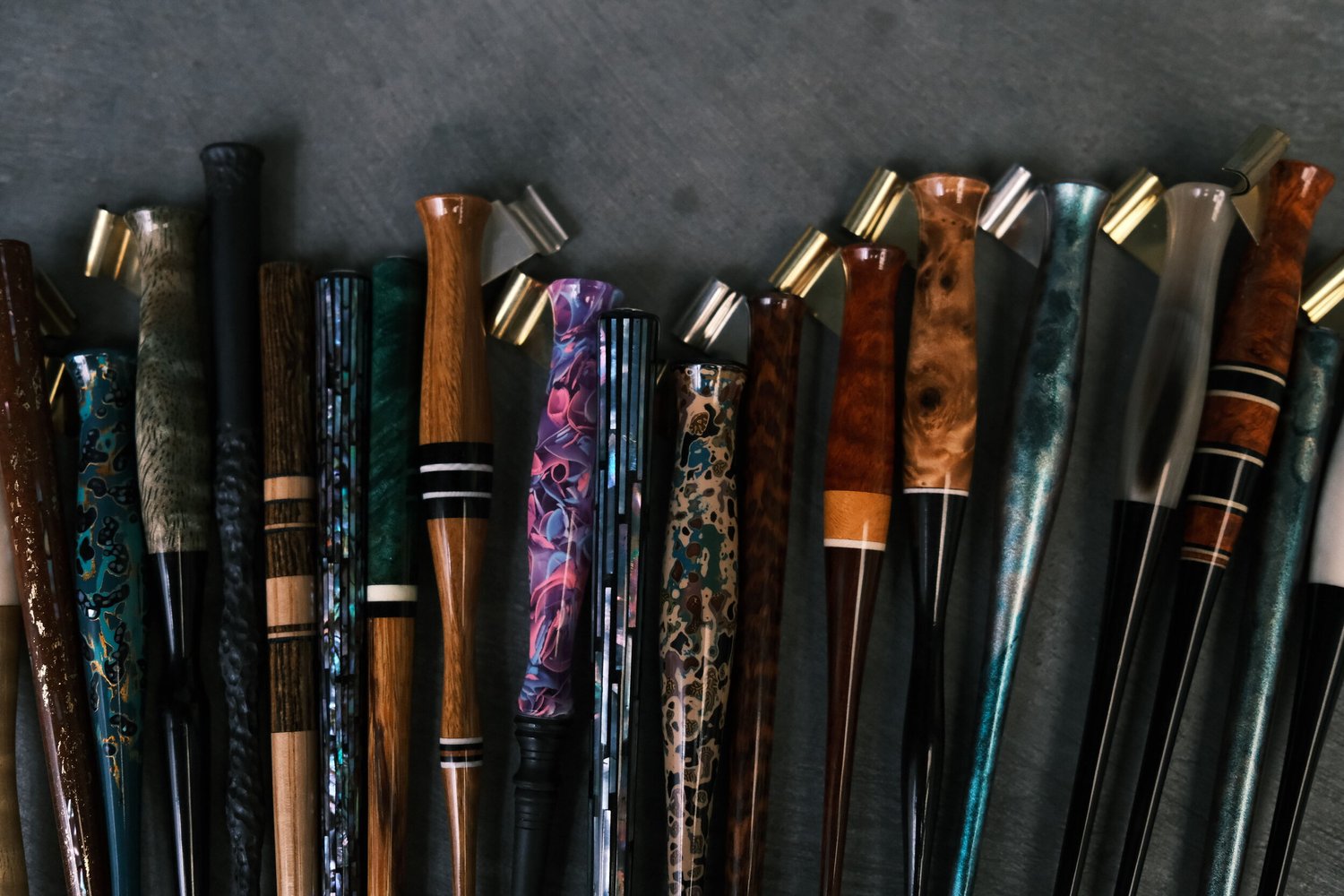
- Oblique holder: The nib sits in a side flange that offsets it from the barrel. The nib points slightly to the side while your hand stays in a more natural writing position.
That small offset can change how easily the nib lands square on the page, meaning both tines touch evenly and the slit stays aligned with the direction of the stroke.
Slant control
Straight holder and slant
A straight holder asks you to create slant mostly through paper rotation and arm movement. Many calligraphers rotate the page so downstrokes are comfortably pulled toward the body, then keep the nib aligned as they move.
Strength: Very direct feeling and simple setup.
Tradeoff: If the page is not rotated enough, the nib can feel like it wants to skate or catch because the tines are not meeting the paper evenly.
Oblique holder and slant
An oblique holder can often make a right-leaning script feel more natural for many right-handed writers, largely because it helps bring the nib into alignment with the writing angle without forcing the wrist to collapse inward. Historically, obliques have been a common choice for pointed-pen scripts with a right slant because of that alignment help.
Strength: Often reduces the urge to twist the wrist to chase a slant.
Tradeoff: You still need good movement habits. An oblique is not a shortcut for spacing, rhythm, or consistent pressure.
Ergonomics
Comfort matters because pointed-pen calligraphy is repetition. If a setup encourages tension, your strokes will show it.
How straight holders tend to feel
- Encourages a familiar “writing with a pen” posture.
- May require more page rotation to keep the nib happy on a right slant.
- If you try to force slant without rotating the paper, the wrist can pronate and bend in ways that feel cramped.
How oblique holders tend to feel
- Often allows a more open wrist angle for right-handed writers working on a right slant.
- Can reduce the feeling that your hand is blocking your view of the nib and baseline.
- May feel unusual at first because the nib is not centered with the barrel.
A gentle reminder: Whatever you choose, aim for a relaxed grip, a neutral wrist, and movement that comes from the forearm and shoulder, not just the fingers.
Nib alignment and scratchiness
Pointed pen nibs are happiest when both tines touch the paper evenly during light pressure, then spread smoothly under added pressure. A common cause of “scratchy nib” frustration is misalignment, but it is not the only culprit.
- If the nib is rotated too far left or right, one tine drags and catches.
- If the pen angle is too steep, the tip can dig in.
- If you push upstrokes instead of pulling lightly, the point can snag fibers.
Other frequent causes include paper tooth or loose fibers, a damaged or mis-shapen tip, ink flow issues, and simply a very sharp nib that feels less forgiving.
Oblique holders can make it easier for many right-handed writers to keep the tines even on a right slant. Straight holders can do this too, but they usually require more intentional page rotation and grip awareness.
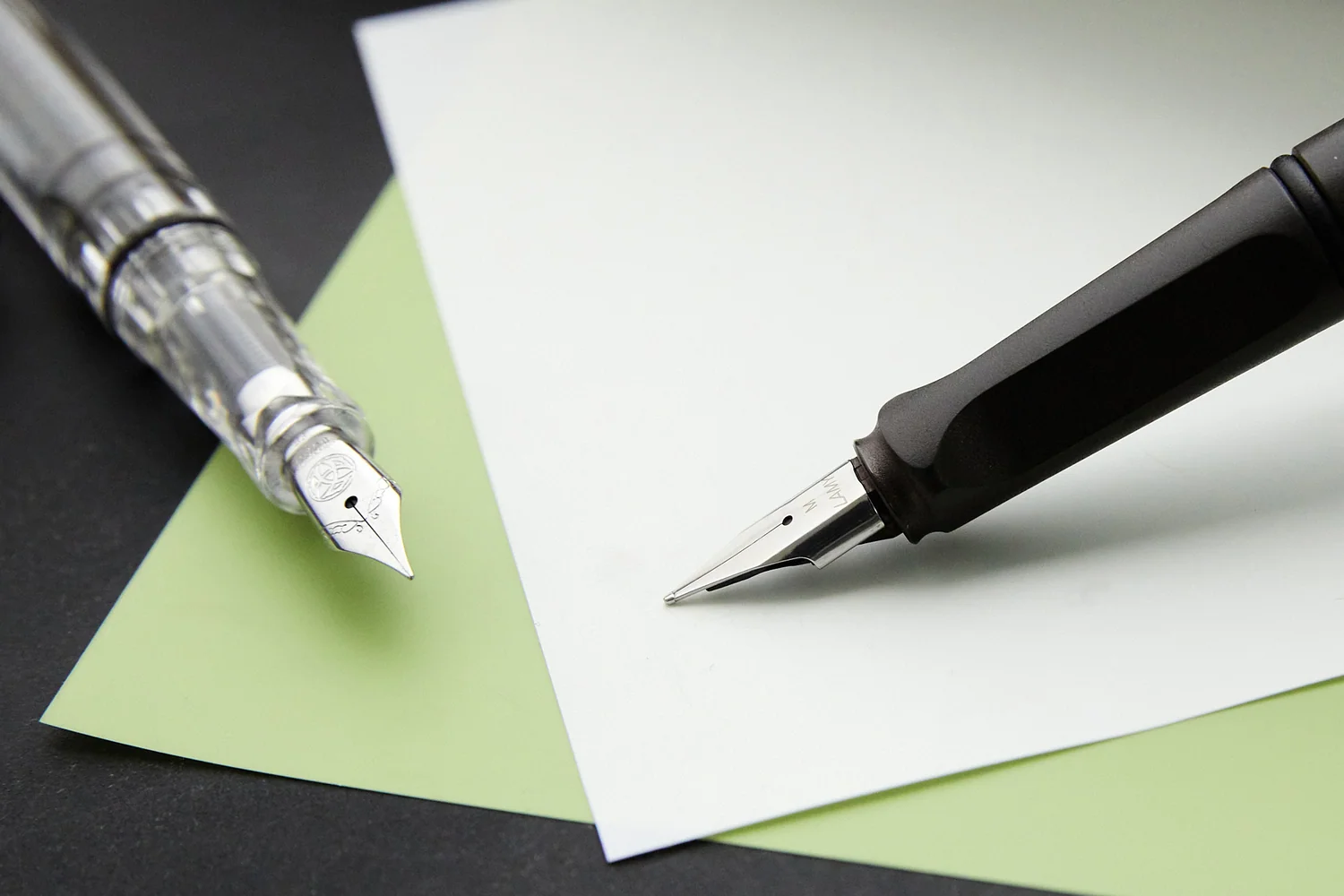
If your paper is fighting your nib, the surface may be part of the issue. Take a peek at paper that keeps pens from fraying. It is written for brush pens, but the big idea carries over: a smoother, ink-friendly sheet that resists feathering and bleed-through usually means less catching and less wear.
Handedness
It can change the answer. Handedness and hand position affect how your arm approaches the baseline and which direction feels natural to pull a stroke.
For right-handed writers
- Oblique is commonly chosen for a Copperplate-style right slant because the offset can help keep the nib aligned without extreme wrist turn.
- Straight works well too, especially if you are comfortable rotating your paper and keeping the nib square.
For left-handed writers
Left-handed calligraphers vary a lot in hand position (underwriting, side-writing, overwriting), so there is no single perfect choice. Many lefties prefer straight holders because the nib orientation is straightforward to manage, though some use left-handed obliques successfully depending on how they approach the line.
If you are left-handed and curious about obliques, look for a holder designed for left-handed use and focus on how evenly the tines land during light upstrokes.
Fit and compatibility
Two holders can both be “oblique” and still feel completely different. These details matter, and they are also where beginners get surprised.
Flange shape (oblique holders)
- Adjustable flange: Lets you gently open or close the metal to fit different nibs. Helpful if you switch nibs often.
- Fixed flange: Simple and sturdy, but pickier about nib fit.
Nib fit basics
Straight holders usually grip nibs with an internal insert (often called a “universal” insert), but “universal” still has limits. Oblique holders rely on the flange, and not every flange likes every nib shape. If you swap between different nib types, expect a little trial and error with fit and seating depth.
Nib seating and depth
A nib that is inserted too far can feel stiff and unresponsive. Too shallow and it wobbles. A secure, straight seat helps with consistent hairlines and smoother shades.
Weight and diameter
- Lighter holders can reduce fatigue for long drills, but may feel less stable for some hands.
- Thicker grips often encourage a looser hold, which is great for smooth pressure changes.
Workspace setup
Before you blame the holder, check the basics: a comfortable chair height, a desk surface that lets your forearm glide, and lighting that keeps your baseline and nib tip easy to see. Then set your paper angle so downstrokes feel like a pull, not a push. This helps both straight and oblique holders behave their best.
Quick decision guide
- Choose a straight holder if: you want the simplest setup, you prefer rotating your paper freely, you are left-handed and unsure about obliques, or you want one holder style that feels closest to everyday writing.
- Choose an oblique holder if: you are right-handed aiming for a consistent right slant, your wrist feels cramped when you try to keep the nib aligned, or you want a tool that often makes tine alignment easier during Copperplate-style movement.
- Choose either if: you are still learning pressure control. Both holders can produce beautiful work, and practice habits matter more than hardware.
Test in 10 minutes
No complicated setup needed. Use smooth paper, a consistent ink, and the same nib for both holders if you can.
- Set a slant guide. Lightly rule pencil lines or use a guide sheet beneath your paper.
- Pull 20 light upstrokes. Listen and feel for snagging. If one side catches repeatedly, check nib rotation and pen angle.
- Pull 20 shaded downstrokes. Aim for even pressure and a clean release at the bottom.
- Write a row of ovals. Ovals reveal alignment problems fast.
- Write “minimum” slowly. This shows whether your entrance strokes and turns stay consistent at speed.
If one holder lets you keep the tines even with less thought, that is a strong sign it fits your mechanics.
Troubleshooting
“My oblique feels like it’s fighting me.”
- Check that the nib is seated straight in the flange and not twisted.
- Try a slightly lower pen angle so the tip glides instead of poking.
- Rotate the paper anyway. Oblique helps, but paper rotation still matters.
“My straight holder makes my nib scratchy.”
- Rotate the paper more so your downstrokes are pulled comfortably toward you.
- Relax your grip. Tight fingers amplify catching.
- Make sure you are not pressing on upstrokes.
“My slant is inconsistent no matter what holder I use.”
- Use a slant guide and slow down until the angle repeats naturally.
- Practice with simple drills before full words. The drills in Tutorials & Practice Drills are perfect for this kind of steady building.
FAQ
Do I need an oblique holder to do Copperplate or Spencerian?
No. Many artists use straight holders beautifully. Oblique holders are popular because they can make a right slant easier to maintain for many right-handed writers, but they are not required.
Will an oblique holder instantly fix my slant?
It will not auto-correct your letters. It can make nib alignment feel more natural, which may reduce tension and improve consistency, but slant still comes from guides, movement, and repetition.
Is one better for beginners?
Beginners can start with either. If you are right-handed and focused on a classic right slant, an oblique can be friendlier. If you want the simplest learning curve and do not mind rotating paper, straight is wonderfully straightforward.
Can I switch back and forth?
Yes. Switching is a skill, and it can actually help you understand alignment. Just keep practice sessions focused, so your muscle memory has time to settle.
A small, steady recommendation
If you are undecided, pick the holder that helps you stay relaxed. A relaxed wrist plus consistent drills will do more for your slant than any tool upgrade. When you are ready for more lettering inspiration beyond pointed pen, come wander through Styles & Techniques with me. Every beautiful word starts with a simple swoop and a smile.